

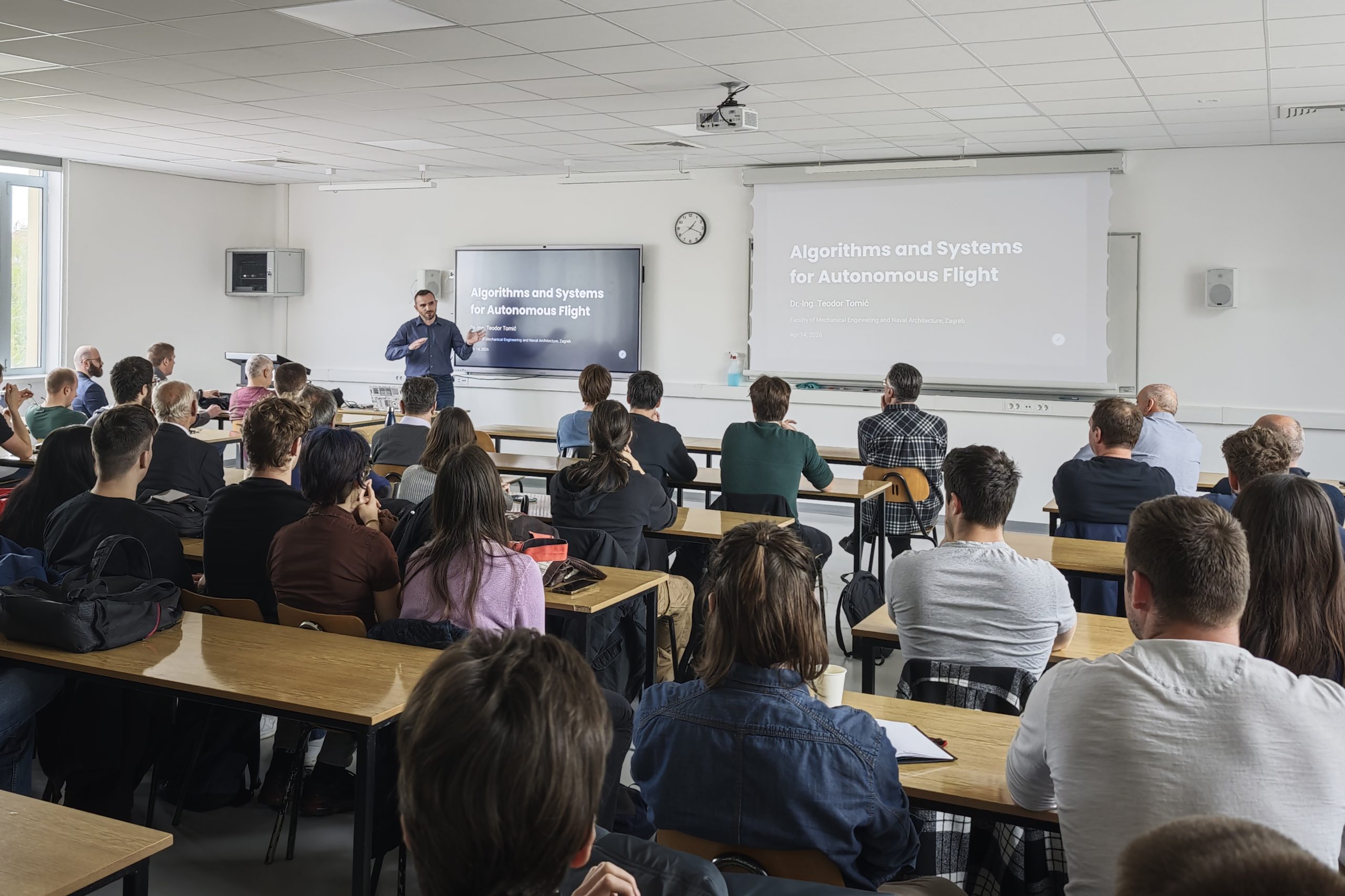
On Tuesday, April 14, 2026, a guest lecture by Dr. Eng. Teodor Tomić titled „Algorithms and Systems for Autonomous Flight“ was held at the Faculty of Mechanical Engineering and Naval Architecture of the University of Zagreb, as part of the Autonomous Systems course in the Mechatronics and Robotics study program.
The lecture attracted a large number of students interested in the field of autonomous aircraft and advanced robotic systems, with a focus on real-world engineering solutions developed in the industry.
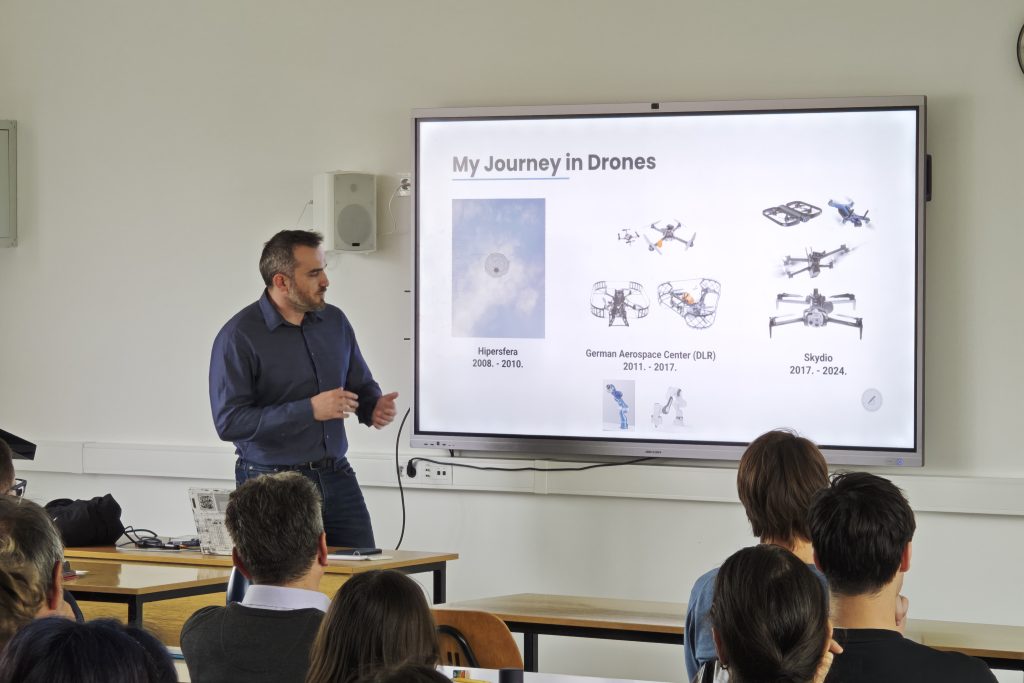
Teodor Tomić is a former student of FSB, where he completed his master's degree, after which he earned his doctorate at the German Aerospace Center (DLR) in Munich. His scientific work was recognized with the Georges Giralt award for the best robotics doctorate in Europe. He continued his professional career at Skydio, one of the leading companies in the field of autonomous drones, where he played a key role in the development of autonomous navigation systems. Today, he works at DoorDash Labs, where he leads the autonomy development team.
In the first part of the lecture, the speaker offered a personal reflection on his career path, highlighting key steps from his studies at FSB, through his doctoral research in Germany, to his work on complex industrial systems in Silicon Valley. He particularly emphasized the difference between academic and industrial approaches to problem-solving, as well as the importance of practical implementation of theoretical knowledge.
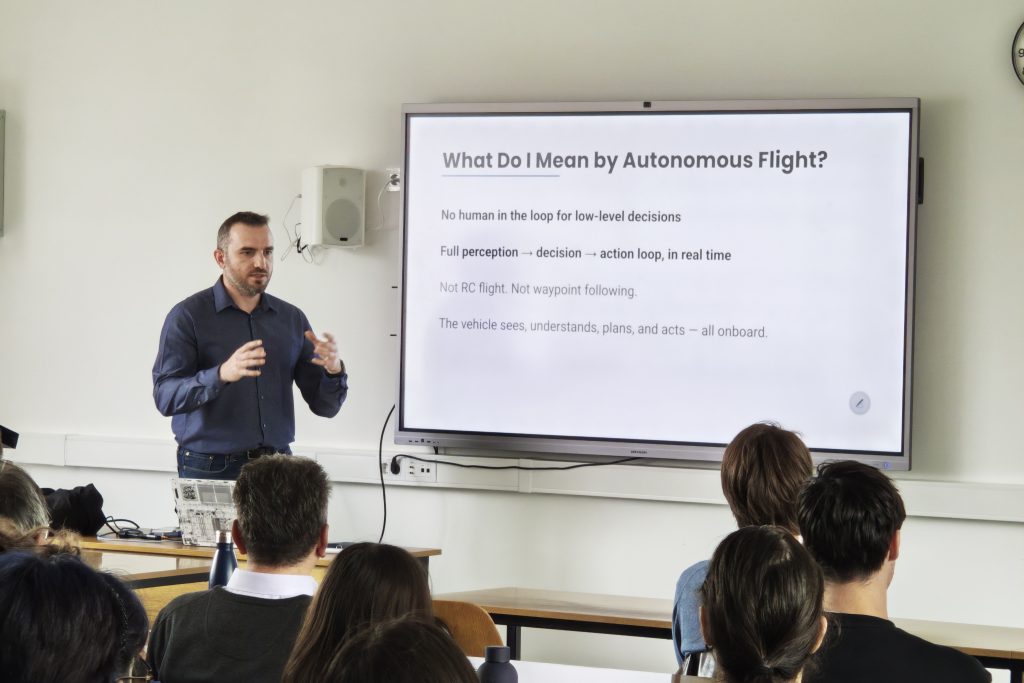
The main part of the lecture focused on the structure of an autonomous flight system and its associated algorithms. Through concrete examples, the entire drone control chain was demonstrated—from environmental perception using sensors, through obstacle avoidance and path planning, to real-time control. Special attention was given to the challenges of GPS-denied navigation, which requires combining multiple data sources and using advanced estimation methods for reliable position determination. It was also shown how the application of deep learning methods, particularly neural networks, can significantly enhance environmental detection and understanding, thereby increasing the reliability of autonomous flight in complex conditions.
Through a combination of theory and concrete industrial examples, students gained a clearer picture of what autonomous system development looks like in practice, as well as the key competencies required to work in this rapidly growing field.
The interest and questions from students after the lecture further demonstrated the importance of such events, which allow direct insight into modern technologies and connect academic education with real engineering challenges.
 The project was co-financed by the European Union from the European Regional Development Fund
The website was co-financed by the European Union from the European Regional Development Fund.
The content of the website is the sole responsibility of the Faculty of Mechanical Engineering and Naval Architecture.