


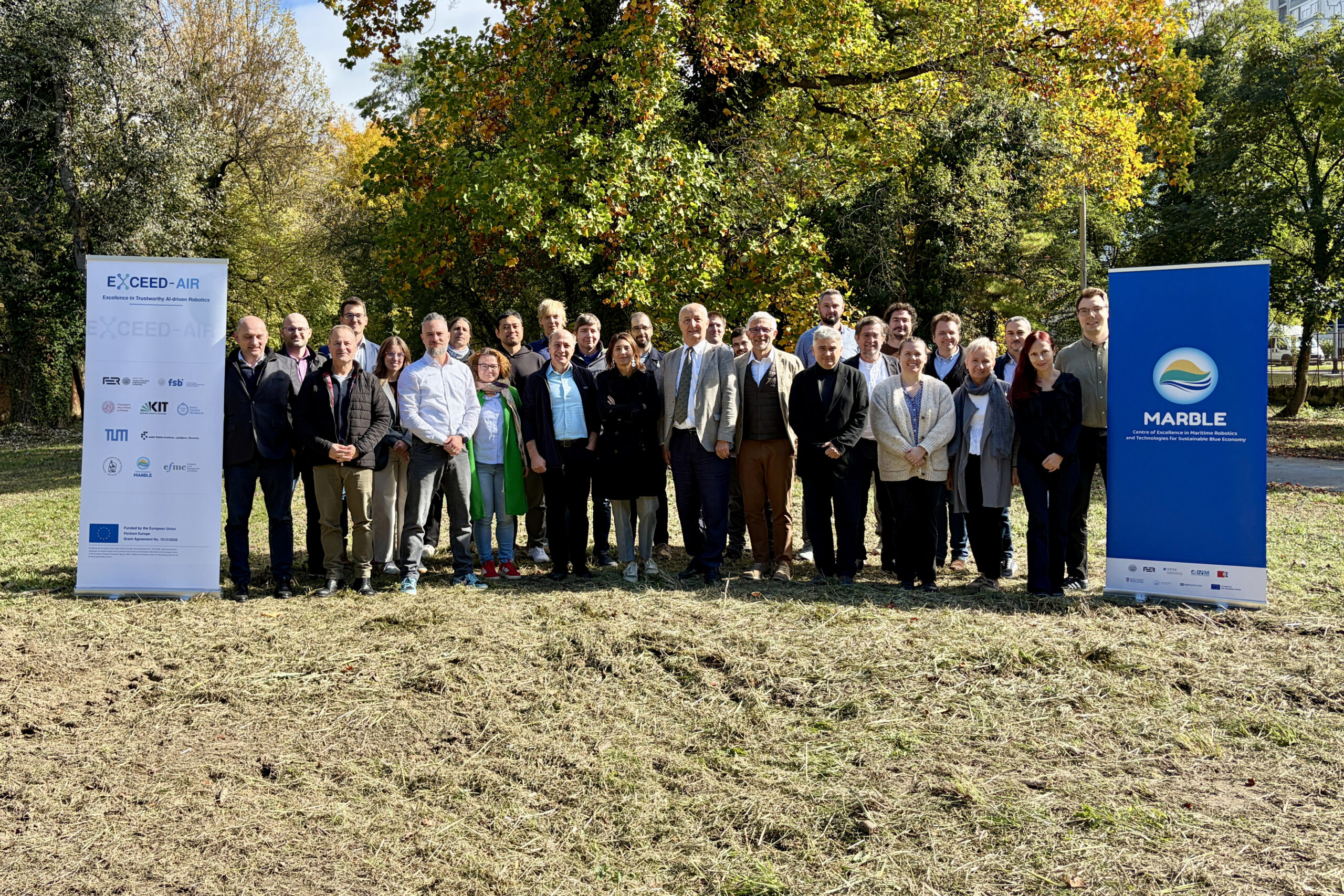
The Faculty of Mechanical Engineering and Naval Architecture (FSB) at the University of Zagreb is a partner in the European project EXCEED-AIR – EXCellence Initiative for European Empowerment and Development in AI-Driven Robotics, which officially commenced on 1 October 2026. The project is funded by the Horizon Europe programme under the European Excellence Initiative and brings together ten partner organisations from six European countries. The total project budget amounts to €5 million, of which €370,687.50 has been allocated to FSB. The project will run for five years, until 30 September 2031.
The project lead at FSB is Associate Professor Marko Švaco, PhD. The project is coordinated by the Faculty of Electrical Engineering and Computing at the University of Zagreb (FER) and led by Professor Ivan Petrović, PhD. The first consortium meeting was held on 13 and 14 October 2026 at the premises of FER’s MARBLE Centre of Excellence.
The main objective of the project is to establish a long-term and sustainable European alliance of excellence in AI-driven robotics. By connecting research teams, expertise and infrastructure, the project will strengthen the scientific and innovation capacities of partner institutions, particularly in countries covered by European widening participation and excellence measures, while promoting the transfer of research results into industry and society.
Participation in the project provides FSB with opportunities to strengthen international research collaboration, facilitate knowledge exchange and develop joint research activities in robotics and artificial intelligence. Applications in smart manufacturing, industrial automation, and human–robot collaboration are of particular relevance, as they link the development of advanced robotic systems with the needs of industry.
Project activities include improving research assessment and career development practices, strengthening research management, and providing professional development, mentoring and international mobility opportunities for researchers and professional staff. The partners will develop a joint research and innovation programme and establish a shared virtual laboratory connecting their research platforms and enabling experiments to be conducted across multiple locations. Digital infrastructure for collaboration, digital twins, and tools for secure data sharing and research reproducibility will also be developed.
Joint research will focus on four strategic areas of artificial intelligence applications in robotics: robust perception and scene understanding, learning and adaptation in unstructured environments, real-time planning and decision-making with human considerations, and heterogeneous multi-agent robotic systems.
The methods and algorithms developed will be applied and validated in assistive robotics for older adults and healthcare, smart manufacturing and industrial automation, as well as maritime systems for environmental monitoring and infrastructure inspection. Particular attention will be paid to human-centred robotics, trustworthy artificial intelligence, data protection and the principles of open science.
The project consortium consists of the Faculty of Electrical Engineering and Computing, University of Zagreb (FER), Croatia, as the coordinator; the Jožef Stefan Institute (JSI), Slovenia; the Faculty of Mechanical Engineering and Naval Architecture, University of Zagreb (FSB), Croatia; KTH Royal Institute of Technology (KTH), Sweden; the Technical University of Munich (TUM), Germany; the Karlsruhe Institute of Technology (KIT), Germany; the University of Padua (UNIPD), Italy; the Croatian Academy of Sciences and Arts (HAZU), Croatia; the MARBLE Centre of Excellence, Croatia; and European Fund Management Consulting (EFMC), Estonia.
The project will promote collaboration with companies, start-ups, regional innovation ecosystems and citizens through the co-design of applications, demonstrations of robotic technologies and public engagement activities. Through its participation in EXCEED-AIR, FSB will further strengthen its international research connections and contribute to the development and application of advanced robotic technologies in industry and society.
 The project was co-financed by the European Union from the European Regional Development Fund
The website was co-financed by the European Union from the European Regional Development Fund.
The content of the website is the sole responsibility of the Faculty of Mechanical Engineering and Naval Architecture.